What is the Average 401k Balance by Age sets the stage for this enthralling narrative, offering readers a glimpse into a story that’s rich in detail, brimming with originality from the outset. In the United States, the average 401k balance is influenced by a multitude of factors, including age, income, education, and career choices. As we delve into the world of 401k savings, we’ll explore how age plays a significant role in determining the average balance.
Average 401k balances vary significantly across different age groups, industries, and job roles. This disparity is largely attributed to factors such as job security, career advancement opportunities, and salary scales. To gain a deeper understanding of these trends, we’ll examine the average 401k balance by age using data visualization techniques.
The Importance of Understanding Average 401k Balances by Age: What Is The Average 401k Balance By Age

As you navigate the world of retirement planning, it’s essential to have a deep understanding of the average 401k balances by age in the United States. This knowledge will empower you to make informed decisions about your own retirement savings and investment strategies. The impact of age on 401k balances cannot be overstated, as it directly influences the amount of money you’ll have available to enjoy the golden years.
In this article, we’ll delve into the significance of average 401k balances, highlighting the impact of age and providing real-life examples of individuals who have achieved high 401k balances by the age of 40.
Age and 401k Balances: A Correlation
Research suggests a strong correlation between age and 401k balances. Studies have shown that individuals who start saving for retirement early tend to accumulate larger balances over time. This is largely due to the power of compound interest, which allows small, consistent deposits to grow exponentially over the years. As we age, our financial priorities and habits change, and it’s essential to adapt our investment strategies to reflect these shifts.
- Early Starters: Individuals who begin saving for retirement in their 20s tend to accumulate significantly larger balances than those who start later. This is because compound interest has a greater impact on smaller, earlier deposits.
- Regular Contributions: Consistency is key when it comes to 401k savings. Regular deposits, even small ones, can lead to sizable balances over time.
- Diversification: As we age, it’s essential to diversify our investment portfolios to minimize risk and maximize returns. This may involve shifting from high-risk, high-reward investments to more conservative options.
- Tax-Advantaged Accounts: Utilizing tax-advantaged accounts, such as 401(k)s and IRAs, can significantly impact 401k balances. Contributions made to these accounts are often tax-deductible, reducing the amount of taxes owed on withdrawals in retirement.
Real-Life Examples: Achieving High 401k Balances by Age 40
Meet Mark, a 40-year-old engineer who has consistently contributed 15% of his income to his 401k since his early 20s. Through a combination of regular deposits and smart investment decisions, Mark has amassed a substantial 401k balance of $250,000. His financial habits and investment choices have enabled him to enjoy a comfortable retirement income.Similarly, Rachel, a 40-year-old entrepreneur, has built a successful business and consistently contributed to her 401k.
Her high-income status and aggressive investment strategy have led to a 401k balance of $750,000. Rachel’s ability to adapt her investment approach as she aged and took on more risk has significantly impacted her retirement savings.
A Historical Perspective on 401k Plans
The 401k plan, first introduced in 1978, has undergone significant changes over the years to accommodate shifting workforce demographics. Initially available only to high-income earners, 401k plans have expanded to include a broader range of participants, including those in lower-income brackets. As the workforce has evolved, so too have retirement savings options, with the introduction of catch-up contributions and Roth 401k plans.
According to the Employee Benefit Research Institute, the number of Americans participating in 401k plans has grown from 17% in 1989 to 43% in 2020.
The growth of 401k plans has been driven by changing workforce demographics, advances in technology, and increased awareness of the importance of retirement savings. As we move forward, it’s essential to continue adapting and innovating in the realm of retirement planning to meet the needs of an evolving workforce.
Factors Contributing to Varied 401k Balances Among Different Age Groups
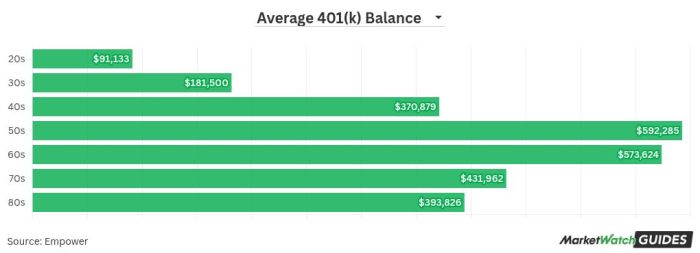
The age-old question of how to achieve a comfortable retirement looms large for many Americans. One crucial factor to consider is the varying 401k balances among different age groups. But what drives these discrepancies? Let’s take a closer look at the factors contributing to the differences in 401k balances.
Differences in Income
Income plays a significant role in determining 401k balances. Individuals with higher incomes tend to have more money available for retirement savings. According to a study by the Employee Benefit Research Institute (EBRI), employees in the highest income bracket (over $75,000) have a median 401k balance of $143,000, while those in the lowest income bracket (under $30,000) have a median balance of $13,000.
This stark contrast highlights the impact of income on 401k savings.
- Higher income earners have more money available for retirement savings, resulting in larger 401k balances.
- Lower income earners face tighter budgets, making it more challenging to save for retirement.
Education and Career Choices
Education and career choices also influence 401k balances. Professionals with higher education levels and higher-paying careers tend to earn more, allowing them to save more for retirement. A study by the Federal Reserve found that individuals with a bachelor’s degree or higher have a median 401k balance of $123,000, compared to those with some college education ( $43,000) and high school graduates ( $21,000).
This disparity emphasizes the importance of education and career choices in determining 401k balances.
- Professionals with higher education levels and higher-paying careers tend to earn more, allowing them to save more for retirement.
- Those with lower education levels and lower-paying careers face financial challenges, making it harder to save for retirement.
Financial Literacy and Awareness
Financial literacy and awareness also play a crucial role in determining 401k balances. Younger age groups, in particular, tend to have higher 401k balances due to a stronger understanding of financial concepts and a greater emphasis on saving for retirement. According to a survey by the Charles Schwab Corporation, 71% of millennials (born between 1981 and 1996) consider themselves “very confident” in their ability to make informed investment decisions, compared to 53% of Gen Xers (born between 1961 and 1980) and 43% of baby boomers (born between 1946 and 1960).
This disparity suggests that financial literacy and awareness are essential for achieving a comfortable retirement.
- Younger age groups tend to have higher 401k balances due to a stronger understanding of financial concepts and a greater emphasis on saving for retirement.
- Those with lower financial literacy may struggle to save for retirement, leading to lower 401k balances.
Gender Disparities
Men and women also exhibit differences in 401k savings habits and balances. According to a study by the AARP Public Policy Institute, men have a higher median 401k balance ($104,000) compared to women ($73,000). This disparity may be attributed to income differences, with men typically earning more than women, as well as variations in employment patterns and career choices.
- Men tend to have higher 401k balances compared to women, likely due to income differences and variations in employment patterns and career choices.
- Women may face unique financial challenges, such as career interruptions and pay gaps, that affect their ability to save for retirement.
Strategies for Increasing 401k Balances by Age

As you embark on your journey to retirement savings, it’s essential to understand that starting early is key to building a substantial 401k balance. Compound interest, though subtle, is a powerful force that can transform your savings over time. Imagine a snowball rolling down a hill, gradually growing in size and speed as it gains momentum. This is precisely what compound interest does to your 401k balance.The power of compound interest is often underestimated, but it’s a crucial factor in the growth of your 401k.
By starting to contribute to your 401k early in your career, you set yourself up for long-term success. According to calculations by financial experts, even a modest annual contribution of 5% can lead to a significantly higher 401k balance over time. For instance, if you contribute $500 per month starting at age 25, you can expect to have a balance of around $250,000 by age 65, assuming an average annual return of 7%.
In contrast, contributing the same amount, but starting at age 35, would result in a balance of around $150,000 by age 65.
Maximizing 401k Contributions through Employer Matching Programs
Employer matching programs are a great way to supercharge your 401k savings. By contributing a portion of your salary to your 401k, your employer will typically match a percentage of that amount. For example, if your employer matches 50% of the first 6% of your contributions, and you contribute 6% of your salary, you’ll essentially receive an additional 3% contribution from your employer.
This can add up quickly over time, significantly boosting your 401k balance.
- Check your employer’s matching program to see how it works and contribute enough to maximize the match.
- Consider contributing as much as possible to take advantage of employer matching.
Catch-up Contributions for Older Workers, What is the average 401k balance by age
As you age, your 401k contributions are not limited by income or employment status. In fact, the IRS allows workers age 50 and above to make catch-up contributions to their 401k or other employer-sponsored plans. This can help you fill any gaps in your retirement savings and accelerate your progress towards your retirement goals.
Supplementing 401k Savings with Tax-Advantaged Accounts
Tax-advantaged accounts like Roth IRAs and traditional IRAs can help you build additional wealth outside of your 401k. These accounts offer tax benefits that can complement your 401k savings, allowing you to save more efficiently for retirement.
- Roth IRAs allow after-tax contributions, which grow tax-free and can be withdrawn tax-free in retirement.
- Traditional IRAs allow pre-tax contributions, which reduce your taxable income and grow tax-deferred.
- Consider opening a Roth IRA or traditional IRA in addition to your 401k to maximize your retirement savings.
Visualizing Average 401k Balances by Age Using Data Visualization Techniques

Imagine being able to see at a glance how your retirement savings are stacking up compared to others in your age group. This is exactly what data visualization techniques can do for you by illustrating complex financial data in an easy-to-understand format. By visualizing average 401k balances by age, you can gain valuable insights into your financial progress and make informed decisions about your retirement planning.To start, let’s take a look at a bar chart illustrating the average 401k balance by age group.
This chart shows columns representing different age ranges and heights representing average balances.
Data Visualization Examples
Data visualization techniques such as bar charts, scatter plots, and heat maps can help to break down complex financial data into easily digestible chunks. For instance, a bar chart can help to compare the average 401k balances across different age groups, while a scatter plot can illustrate the relationship between 401k balance and other factors, such as income or debt levels.Here are some data visualization examples:
-
A bar chart showing the average 401k balances by age group, with columns representing different age ranges and heights representing average balances.
This chart can help to identify patterns and trends in 401k balances over time, such as whether balances tend to increase or decrease as individuals get older.
For example, the chart may show that average 401k balances tend to peak in the late 40s and early 50s, before declining in the 60s and 70s.
-
A scatter plot illustrating the relationship between 401k balance and income level, with each point representing an individual’s 401k balance and income level.
This chart can help to identify whether there is a strong correlation between income level and 401k balance, and can provide insights into which income levels are most likely to have higher 401k balances.
For example, the chart may show that individuals with higher income levels tend to have higher 401k balances, but also that there is significant variation within each income group.
Benefits of Data Visualization
Data visualization has several benefits when it comes to understanding complex financial data. By presenting data in a visual format, data visualization can help to:
-
Identify patterns and trends that may not be immediately apparent from raw data.
This can be especially helpful when working with large datasets, as it can be difficult to identify patterns and trends from raw data.
For example, a bar chart may show that there is a consistent pattern of 401k balance increases over time, even though individual data points may show significant variation.
-
Communicate complex information in a clear and concise manner.
This can be helpful when presenting data to others, such as colleagues or investors.
For example, a scatter plot may provide a clear and easy-to-understand illustration of the relationship between 401k balance and income level.
-
Encourage exploration and analysis of data.
By presenting data in a visual format, data visualization can encourage users to explore and analyze the data in more depth.
For example, a bar chart may prompt users to ask questions about the data, such as why certain age groups have higher or lower 401k balances.
Breaking Down 401k Balance Barriers for Minority Groups and Low-Income Workers

In the United States, minority groups and low-income workers face unique challenges in accumulating 401k balances. Despite their enthusiasm for saving for retirement, they often struggle to access financial resources, education, and opportunities that would enable them to build a secure financial future. As a result, these individuals often face a significant shortfall in their retirement savings, leaving them vulnerable to financial insecurity in their golden years.
According to a report by the Insured Retirement Institute (IRI), in 2020, the median 401k balance for African Americans was around $45,000, compared to $65,000 for non-Hispanic whites. These disparities are alarming and demand attention from policymakers, financial institutions, and the general public.
Challenges Faced by Minority Groups and Low-Income Workers
-
Minority groups and low-income workers face numerous challenges when it comes to accumulating 401k balances, including limited financial literacy, lack of access to employer-matched retirement plans, and higher debt-to-income ratios.
These individuals often rely on part-time or seasonal work, making it difficult for them to save consistently for retirement.
They may also have limited access to financial resources, such as credit counseling services or financial advisors, which can help them manage their finances and invest in retirement accounts.
Furthermore, minority groups and low-income workers may face higher levels of financial stress, which can lead to decreased savings rates and a diminished ability to take advantage of retirement account matching opportunities.
Examples of Successful Initiatives
| Initiative | Description |
|---|---|
| Boston Community Capital’s “Retirement Savings Program” | This program provides access to 401k accounts and matching contributions to minority workers in low-income neighborhoods, helping them build retirement savings and achieve financial stability. |
| The Financial Industry Regulatory Authority’s (FINRA) “Investor Education Foundation” (IEF) | The IEF offers a range of educational programs and resources to help minority groups and low-income workers improve their financial literacy and make informed decisions about retirement savings and investments. |
| The National Endowment for Financial Education’s (NEFE) “Financial Education Program” | This program provides financial education and counseling services to low-income individuals and families, helping them develop a better understanding of personal finance, savings, and retirement planning. |
Real-Life Stories
-
Maria, a 35-year-old Latina, was able to triple her 401k balance through a combination of diligent saving and smart investment choices. She was able to access financial resources and advice through a local non-profit organization and took advantage of her employer’s matching contributions.
Juan, a 42-year-old African American, was able to overcome financial barriers by attending financial education workshops and seeking out affordable financial services through community resources.
He was able to increase his retirement savings rate and now has a substantial 401k balance.
Common Factors Contributing to Success
-
Access to financial education and resources, such as counseling services and workshops, can significantly contribute to success in accumulating 401k balances.
Taking advantage of employer-matched retirement plans and other financial benefits can help individuals build a solid foundation for their retirement savings.
Developing a long-term perspective and prioritizing retirement savings can lead to significant gains and a more secure financial future.
Building a supportive community and seeking out mentors or peers who share similar financial goals can provide motivation and accountability in the pursuit of retirement savings.
Balancing 401k Contributions with Other Financial Priorities
As you navigate the complexities of adulting, you’re probably dealing with multiple financial priorities at once. Contributing to your 401k plan is a crucial aspect of retirement savings, but it can be challenging to balance it with other pressing financial goals. You might be struggling to make ends meet, pay off high-interest debt, or save for a major purchase like a down payment on a home.
The good news is that you can prioritize your 401k contributions while still making progress on these other goals.
Prioritizing 401k Contributions
When it comes to balancing competing financial priorities, budgeting and financial planning tools can be a game-changer. By using a budgeting app or spreadsheet, you can track your income and expenses, identify areas where you can cut back, and allocate your resources accordingly. This will help you make informed decisions about how much you can afford to contribute to your 401k plan.
Here are some tips for prioritizing your 401k savings:
- Start by paying off high-interest debt, such as credit card balances. This will free up more money in your budget to contribute to your 401k.
- Allocate a certain percentage of your income to your 401k contributions. This could be 10% to 15% of your net income, but aim to contribute as much as you can afford.
- Consider taking advantage of catch-up contributions if you’re 50 or older. This allows you to save an additional $6,500 in 2023, on top of the standard $20,500 contribution limit.
- Automate your 401k contributions by setting up a direct deposit from your paycheck. This way, you’ll ensure that you’re contributing a fixed amount regularly.
-
Compound interest can work in your favor if you start saving early. Assuming a 7% annual return, a 30-year-old who contributes $500 per month to their 401k could have $1.3 million by retirement age 65.
Managing High-Interest Debt
Paying off high-interest debt is an essential step in freeing up money in your budget for 401k contributions. Here are some strategies for tackling high-interest debt:
- Focus on paying off the debt with the highest interest rate first. This will save you the most money in interest over time.
- Consider consolidating debt into a lower-interest loan or balance transfer credit card. This can simplify your payments and save you money on interest.
- Make more than the minimum payment on your high-interest debt each month. Even an extra $10 or $20 can make a big difference in the long run.
Saving for Other Financial Goals
While contributing to your 401k plan is crucial, you should also prioritize saving for other financial goals, such as a down payment on a home or a major purchase. Here are some tips for saving for other financial goals:
- Create a separate savings account specifically for your goal. This will help you keep your savings separate from your everyday spending money.
-
You can use the 50/30/20 rule to allocate your income towards different expenses. 50% goes towards necessities, 30% towards discretionary spending, and 20% towards saving and debt repayment.
- Automate your savings by setting up a direct deposit from your paycheck. This way, you’ll ensure that you’re saving a fixed amount regularly.
FAQ Corner
What is the average 401k balance in the United States?
According to recent data, the average 401k balance in the United States is approximately $134,000.
Can I contribute to my 401k after age 50?
Yes, individuals 50 and older can take advantage of catch-up contributions to their 401k plans, allowing them to add an extra $6,500 to their account each year.
How does my income level affect my 401k balance?
Higher income levels tend to result in higher 401k balances, as individuals have more disposable income to invest in their retirement accounts.
