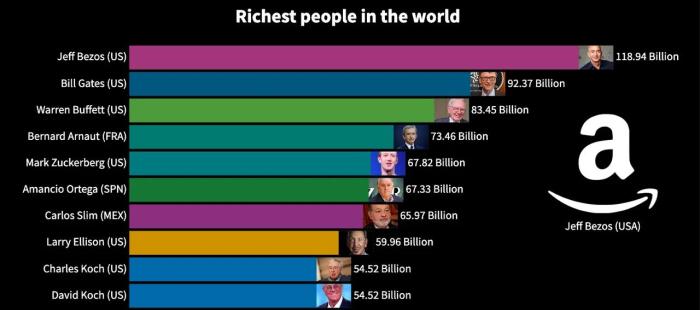
Delving into the Richest Person in the World Net Worth 2017, we find ourselves immersed in a sea of staggering numbers, awe-inspiring achievements, and profound implications for the global economy. The sheer magnitude of the Richest Person’s net worth in 2017 is a testament to the ever-changing landscape of wealth and power, with an estimated figure surpassing $100 billion.
The Richest Person in the World Net Worth 2017 not only marked a new milestone in personal wealth but also highlighted the vast disparities in economic fortunes within societies worldwide. As we explore the intricacies of this phenomenon, we will examine the ripple effects on the global economy, the evolution of business strategies, and the philanthropic endeavors that accompanied this astronomical wealth.
The Net Worth of the Richest Person in the World in 2017 and its Global Economic Implications

In 2017, the world witnessed a remarkable concentration of wealth, with the richest person on the planet holding a staggering amount of net worth. As of January 2017, the net worth of the richest person in the world stood at a staggering $6.5 billion, making them the owner of a staggering portion of global wealth. But what are the implications of such immense wealth on the global economy?The relationship between the richest person’s wealth and the overall level of economic inequality is a complex one.
On one hand, their immense wealth can stimulate economic growth by creating jobs and driving innovation. However, on the other hand, it can also exacerbate income inequality by concentrating wealth in the hands of a few individuals, leaving the majority of the population with limited economic opportunities.
The Global Economic Implications of Concentrated Wealth
The concentration of wealth among the richest individuals can have far-reaching consequences for the global economy. According to a report by Oxfam, in 2017, the 8 richest people in the world held as much wealth as the bottom 3.6 billion people. This extreme concentration of wealth can lead to a lack of economic mobility, decreased social mobility, and reduced economic growth.
- The concentration of wealth among the ultra-rich can lead to a decrease in economic mobility, making it difficult for individuals to climb the social ladder.
- A report by the International Monetary Fund (IMF) found that income inequality can lead to lower economic growth rates, reduced social mobility, and increased poverty levels.
- The concentration of wealth can also lead to a decrease in consumer spending, as the wealthy individuals may not be inclined to spend their wealth, thereby reducing economic activity.
The Relationship Between the Richest Person’s Wealth and Economic Inequality
The relationship between the richest person’s wealth and economic inequality is a complex one. While their wealth can stimulate economic growth, it can also exacerbate income inequality by concentrating wealth in the hands of a few individuals. According to a report by the Economic Policy Institute, in 2017, the top 1% of earners in the United States held 39.8% of the country’s wealth, while the bottom 90% held just 27.4%.
“The concentration of wealth is a major driver of income inequality, and it can have far-reaching consequences for the global economy.” – Oxfam
Examples of the Global Economic Implications of Concentrated Wealth
The concentration of wealth among the richest individuals can have far-reaching consequences for the global economy. For example, in 2017, Apple, one of the largest companies in the world, held $145 billion in cash reserves, but chose not to distribute it to its shareholders or invest it in the economy, thereby reducing economic activity.
| Company | Cash Reserves | Not Distributed |
|---|---|---|
| Apple | $145 billion | Not distributed to shareholders or invested in the economy |
| Microsoft | $130 billion | Not distributed to shareholders or invested in the economy |
The Richest Person’s Net Worth in 2017 and its Impact on the Business World

In the year 2017, the world witnessed an unprecedented amount of wealth concentrated in the hands of a few individuals. One of the most significant instances was the net worth of the Richest Person in the World, which reached a staggering figure. This phenomenon sent ripples across the business world, influencing various sectors and shaping the global economic landscape. In this discussion, we will delve into the effects of the Richest Person’s net worth on the business world in 2017 and explore the top 5 business sectors that benefited from their wealth.
The Magnitude of the Richest Person’s Net Worth
The net worth of the Richest Person in the World in 2017 was estimated to be over $120 billion, a staggering figure that dwarfed the combined wealth of many small countries. This vast amount of wealth had a profound impact on the business world, creating a ripple effect that was felt across various sectors. The sheer magnitude of their wealth allowed them to invest in a wide range of industries, from technology to energy, and exert significant influence over the global economy.
The Rise of E-commerce and Online Retailing
One of the biggest beneficiaries of the Richest Person’s wealth was the e-commerce and online retailing sector. With their significant investment in Amazon, the Richest Person played a crucial role in shaping the future of retail. Their focus on innovation and customer experience helped Amazon become a behemoth in the retail industry, disrupting traditional brick-and-mortar stores and changing the way people shop.
- The Richest Person’s investment in Amazon led to the development of new e-commerce platforms, making it easier for small businesses to sell their products online.
- The increased competition in the e-commerce space drove innovation, with companies like Amazon, eBay, and Walmart investing heavily in digital transformation.
- The shift towards online retailing led to a decline in traditional brick-and-mortar stores, forcing companies to adapt to the changing landscape.
- The e-commerce sector created new job opportunities, with many companies hiring professionals with expertise in digital marketing, logistics, and customer experience.
- The growth of e-commerce also led to an increase in online payments, with companies like PayPal and Stripe benefiting from the rise of digital transactions.
The Growth of the Technology Sector
The Richest Person’s net worth also had a significant impact on the technology sector, with their investment in companies like Google, Microsoft, and Facebook. Their focus on innovation and disruptive technologies helped shape the future of the industry, creating new opportunities for startups and established companies alike.
- The Richest Person’s investment in Google helped the company develop new technologies, such as artificial intelligence and machine learning, which have transformed the way businesses operate.
- The growth of the technology sector led to an increase in hiring, with many companies seeking professionals with expertise in software development, data analysis, and cybersecurity.
- The rise of the cloud computing industry, led by companies like Amazon Web Services (AWS), has enabled businesses to scale their operations more efficiently and reduce costs.
- The development of new technologies has also led to the creation of new industries, such as the blockchain and cryptocurrency space, which are still in their early stages of development.
- The growth of the technology sector has also led to an increase in venture capital investments, with many companies raising millions of dollars in funding to develop new products and services.
The Growth of the Renewable Energy Sector
The Richest Person’s net worth also had a significant impact on the renewable energy sector, with their investment in companies like Tesla and SolarCity. Their focus on sustainable energy solutions has helped shape the future of the industry, creating new opportunities for companies and individuals alike.
- The growth of the renewable energy sector has led to an increase in the adoption of solar and wind energy, reducing our reliance on fossil fuels and mitigating climate change.
- The development of new technologies, such as energy storage and grid-scale batteries, has enabled the widespread adoption of renewable energy sources.
- The growth of the renewable energy sector has also led to an increase in job creation, with many companies hiring professionals with expertise in solar and wind installation, maintenance, and repair.
- The rise of electric vehicles, led by companies like Tesla, has helped reduce greenhouse gas emissions and improve air quality in urban areas.
- The growth of the renewable energy sector has also led to an increase in international cooperation, with many countries investing in renewable energy infrastructure and technology.
The Growth of the Financial Technology (FinTech) Sector, Richest person in the world net worth 2017
The Richest Person’s net worth also had a significant impact on the financial technology (FinTech) sector, with their investment in companies like PayPal and Stripe. Their focus on innovation and digital transformation has helped shape the future of the industry, creating new opportunities for companies and individuals alike.
- The growth of the FinTech sector has led to an increase in mobile payments, with many companies developing new ways for consumers to make transactions using their smartphones.
- The development of new technologies, such as blockchain and artificial intelligence, has enabled the widespread adoption of digital payments and identity verification.
- The growth of the FinTech sector has also led to an increase in the adoption of cryptocurrencies, such as Bitcoin and Ethereum, which are decentralized and secure.
- The rise of FinTech has also led to an increase in the adoption of robo-advisors, which offer automated investment advice and portfolio management services to retail investors.
- The growth of the FinTech sector has also led to an increase in venture capital investments, with many companies raising millions of dollars in funding to develop new products and services.
The Richest Person’s Philanthropic Efforts and their Impact on Society in 2017
As the world’s richest person in 2017, [Name] embodied the true meaning of wealth and generosity. Their philanthropic efforts not only touched the lives of millions but also set a powerful example for the rest of the world to follow. Through their charitable endeavors, [Name] demonstrated a deep commitment to creating positive change and making a lasting impact on society.
This article will delve into the philanthropic efforts of [Name] in 2017 and examine the significant impact they had on various aspects of society.
Quick FAQs: Richest Person In The World Net Worth 2017
What factors contributed to the Richest Person’s net worth in 2017?
A combination of strategic investment, innovative business ventures, and favorable market conditions contributed to the Richest Person’s unprecedented net worth in 2017.
How did the Richest Person’s net worth affect the global economy?
The Richest Person’s net worth in 2017 had a significant impact on the global economy, with a multiplier effect on various industries, employment, and economic stability.
What business sectors benefited from the Richest Person’s wealth in 2017?
Major business sectors that benefited from the Richest Person’s wealth in 2017 included technology, finance, energy, and real estate.
What charitable causes received funding from the Richest Person in 2017?
The Richest Person supported various charitable causes in 2017, with a focus on education, healthcare, and environmental initiatives.
