Net worth of top 1 percent in world – The disparity in net worth of the world’s top 1 percent has reached unprecedented heights, with the current global economic landscape favoring those at the pinnacle of wealth. As the world becomes increasingly interconnected, this top echelon has managed to accumulate an astonishing amount of wealth, while the masses struggle to make ends meet. The stark reality is that the world’s wealthiest individuals have become exponentially richer, leaving the rest of humanity in their wake.
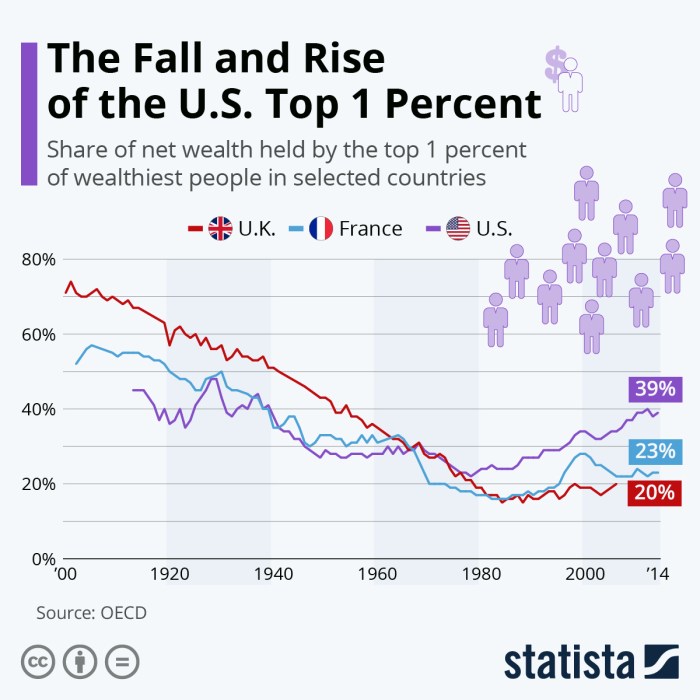
Historical records reveal a stark evolution of wealth concentration among the global elite. From the Industrial Revolution to the present day, pivotal events, technological breakthroughs, and policy shifts have all contributed to the current state of wealth inequality. The net worth of the world’s top 1 percent has become a behemoth, with their collective fortunes dwarfing those of entire nations.
Historical Evolution of Wealth Distribution Among the Global Elite

The notion that wealth is a finite resource, only divisible so many ways, has long been debated by philosophers and economists alike. Over the centuries, societal structures and economic frameworks have shaped the concentration of wealth among the global elite, leading to the current state of affairs. To understand the evolution of wealth distribution, let’s delve into the key events, technological advancements, and policy decisions that have contributed to the current economic landscape.Throughout history, the concentration of wealth has ebbed and flowed, influenced by various factors such as wars, technological innovations, and government policies.
The Industrial Revolution marked a significant turning point, as new manufacturing technologies and mass production techniques enabled the emergence of a global industrial economy. The subsequent rise of multinational corporations and international trade helped to concentrate wealth among the top 1% of the population.
The Rise of Industrial Capitalism (18th-19th Centuries), Net worth of top 1 percent in world
As the Industrial Revolution took hold, entrepreneurs and industrialists accumulated wealth and power at an unprecedented rate. The emergence of new industries, such as textiles and steel, created vast opportunities for capital investment and growth. The concentration of wealth among industrialists and financiers became increasingly evident, as they controlled the means of production, labor, and market access.
- The development of the steam engine and other machine technologies facilitated mass production, enabling the efficient manufacture of goods on a large scale. This, in turn, increased productivity and reduced costs, leading to greater profits for industrialists.
- The rise of joint-stock companies and shareholding allowed for the transfer of wealth among investors, further concentrating power and capital among the elite.
- The emergence of global trade and colonialism enabled the exploitation of resources and labor in distant lands, further enriching the industrial elite.
The Role of Economic Policies and Interventions (20th Century)
The 20th century witnessed significant economic policy shifts, including the formation of the Federal Reserve in the United States and the establishment of Keynesian economics. These developments led to increased government intervention in the economy, often benefiting the wealthy and powerful at the expense of the working class.
- The creation of the Federal Reserve in 1913 granted the U.S. government control over monetary policy, enabling the manipulation of interest rates and money supply to favor the interests of industrialists and financiers.
- The implementation of the New Deal programs during the Great Depression provided temporary relief to the working class, but ultimately reinforced the power of large corporations and financial institutions.
- The adoption of neoliberal economic policies in the 1980s, such as supply-side economics and deregulation, further exacerbated income inequality by reducing government oversight and increasing profit margins for corporations.
The Digital Age and the Concentration of Wealth ( Late 20th-Early 21st Centuries)
The emergence of the digital age has brought about unprecedented opportunities for wealth creation and concentration. The rise of information technology, the internet, and social media has enabled the rapid transfer of wealth, power, and influence across borders and societies.
- The development of global digital networks and platforms has facilitated the emergence of new businesses, such as tech startups, and increased access to capital and markets for entrepreneurs.
- The concentration of wealth among tech moguls, such as Bill Gates and Jeff Bezos, has created a new breed of capitalist leaders who wield immense power and influence.
- The growth of financial markets and asset classes, such as cryptocurrencies and private equity, has further increased the complexity and opacity of wealth distribution, making it increasingly difficult to track and understand.
- The increasing reliance on digital technologies has also created new forms of economic vulnerability, such as cybersecurity risks and data exploitation, which can exacerbate existing social and economic inequalities.
“The concentration of wealth is not an inevitable outcome, but rather the result of deliberate policy choices and economic structures that favor the interests of the few over the many.”
Naomi Klein
Key Characteristics of High-Net-Worth Individuals in the Top 1 Percent

High-net-worth individuals in the top 1 percent have often achieved their wealth through a combination of hard work, strategic decision-making, and a bit of luck. However, there are certain characteristics, skills, and expertise that have contributed to their success. These traits are often developed through education, experience, and a willingness to take calculated risks.The wealthy have a strong drive to succeed and are often willing to invest in themselves, whether through education, networking, or other opportunities.
Many also have a keen sense of business acumen, allowing them to identify opportunities and navigate complex financial situations.
Mastery of Finance and Economics
High-net-worth individuals have a strong understanding of finance and economics, which enables them to make informed investment decisions and navigate the complexities of wealth management. This knowledge allows them to identify investment opportunities, manage risk, and optimize their returns.
- They are familiar with financial theories and models, such as the concept of compound interest and the Efficient Market Hypothesis.
- They have a deep understanding of financial instruments, including stocks, bonds, and derivatives.
- They are skilled at analyzing financial data and making data-driven decisions.
Strategic Networking and Partnerships
Successful high-net-worth individuals have learned the importance of building strategic relationships and partnerships. This may involve networking with other influential people, investing in startups or established businesses, or partnering with experts in various fields.
- They attend exclusive networking events and conferences to connect with other influential individuals.
- They invest in startups or established businesses, often taking an active role in decision-making and strategic planning.
- They partner with experts in various fields, such as law, accounting, or financial planning, to ensure their wealth is managed effectively.
Entrepreneurial Spirit and Risk-Taking
Many high-net-worth individuals have achieved their wealth through entrepreneurship. They have a willingness to take calculated risks, experiment with new ideas, and adapt to changing market conditions.
- They have a history of starting and leading successful businesses, often in competitive industries.
- They are comfortable with ambiguity and uncertainty, and are able to adapt quickly to changing market conditions.
- They are willing to invest in research and development, and are open to experimenting with new ideas.
Effective Time Management and Delegation
High-net-worth individuals often have complex schedules and numerous responsibilities. They have learned the importance of effective time management and delegation, allowing them to prioritize their tasks and focus on high-leverage activities.
- They prioritize their tasks and focus on high-leverage activities, such as investment decisions or business development.
- They delegate tasks to others, often using virtual assistants or outsourcing certain tasks.
- They are skilled at time-blocking, and use tools and technology to streamline their schedule.
Sophisticated Investment Strategies
Successful high-net-worth individuals have often developed sophisticated investment strategies, allowing them to optimize their returns and minimize risk. This may involve investing in alternative assets, using hedging strategies, or leveraging tax-advantaged accounts.
- They invest in alternative assets, such as real estate, art, or private equity.
- They use hedging strategies, such as option buying or selling, to manage risk.
- They leverage tax-advantaged accounts, such as 401(k) or IRA, to optimize their returns.
Commitment to Continuous Learning
High-net-worth individuals often have a commitment to continuous learning, which enables them to stay ahead of the curve and adapt to changing market conditions. This may involve reading books, attending seminars, or participating in online courses.
- They read books and articles on finance, economics, and investing.
- They attend seminars and conferences to connect with other influential individuals.
- They participate in online courses, such as Coursera or edX, to expand their knowledge and skills.
Strategic Philanthropy
Successful high-net-worth individuals have often developed a strategic approach to philanthropy, which enables them to make a meaningful impact and leave a lasting legacy.
- They identify social issues that align with their values and interests.
- They establish charitable foundations or donor-advised funds to support their philanthropic efforts.
- They measure the impact of their philanthropy, and adjust their strategy accordingly.
Impact of wealth concentration on societal development and economic growth.
In recent years, the world has witnessed a stark widening of the wealth gap, with the top 1% of the global elite holding a disproportionate share of the world’s wealth. This phenomenon has far-reaching implications for societal development and economic growth. As the richest individuals accumulate more wealth, the poorer segments of society struggle to access basic necessities, leading to social unrest and economic instability.
Potential risks of wealth inequality
The concentration of wealth in the hands of a few individuals can lead to social unrest, as the disparity between the haves and have-nots grows. This can result in increased crime rates, decreased social cohesion, and a decline in overall quality of life. Furthermore, wealth inequality can lead to a decline in economic mobility, as those who are born into poverty or low-income families find it increasingly difficult to climb the social ladder.
- Reduced economic mobility
- Social unrest
- Decreased societal cohesion
Reduced economic mobility is a key concern when wealth is concentrated among a few individuals. As the gap between the rich and the poor widens, it becomes increasingly difficult for those who are struggling to access better education, healthcare, and job opportunities. This perpetuates a cycle of poverty, as those who are born into low-income families find it challenging to break free.
The concentration of wealth can lead to social unrest, as those who are struggling to make ends meet become increasingly frustrated with the system. This can result in protests, riots, and other forms of civil unrest, which can have devastating effects on communities and economies.
Wealth inequality can lead to a decline in societal cohesion, as those who are struggling to make ends meet become increasingly disconnected from the rest of society. This can result in a decline in social trust, community engagement, and overall well-being.
Relationship between wealth concentration and economic growth
The relationship between wealth concentration and economic growth is complex and multifaceted. Some argue that wealth concentration can lead to economic growth, as the wealthy are more likely to invest in businesses and create jobs. However, others argue that wealth concentration can actually hinder economic growth, as the wealthy become disconnected from the rest of society and fail to invest in areas that benefit the broader population.
Citizens must be seen as the fundamental stakeholder in a nation’s economic system, rather than just customers or human resources.
Arguments for a more evenly distributed wealth
A more evenly distributed wealth can have a number of benefits for economic growth and societal development. For example:
- Increased consumer spending
- Increased access to education and healthcare
- Reduced income inequality
When wealth is more evenly distributed, people are more likely to have disposable income, which can lead to increased consumer spending and economic growth. As people have more money to spend, businesses are able to expand and create jobs, generating a virtuous cycle of economic growth.
When wealth is more evenly distributed, people are more likely to have access to education and healthcare, which are critical for economic growth and development. As people become better educated and healthier, they are better equipped to participate in the workforce and contribute to economic growth.
When wealth is more evenly distributed, income inequality is reduced, which can lead to a more stable and prosperous society. As people become less concerned about their financial security, they are more likely to invest in their communities and contribute to economic growth.
Arguments against a more evenly distributed wealth
On the other hand, some argue that a more evenly distributed wealth can actually hinder economic growth. For example:
- Reduced incentives for entrepreneurship
- Increased tax burden
- Perception of socialism
When wealth is more evenly distributed, entrepreneurs may have reduced incentives to start and grow businesses, as they are not motivated by the potential for high returns. As a result, economic growth may slow down.
When wealth is more evenly distributed, the tax burden may increase, as the wealthy are required to pay a higher tax rate to redistribute wealth to the less fortunate. This can lead to decreased incentives for entrepreneurship and economic growth.
When wealth is more evenly distributed, some may perceive it as socialism, which can be a turn-off for investors and entrepreneurs. As a result, economic growth may slow down.
In conclusion, the relationship between wealth concentration and economic growth is complex and multifaceted. While a more evenly distributed wealth can have numerous benefits for societal development and economic growth, it also has its drawbacks. Ultimately, the key to achieving sustainable economic growth and development lies in striking a balance between wealth distribution and economic incentives.
Global Regulatory Environments for High-Net-Worth Individuals
Regulators around the world are grappling with how to address the specific needs and interests of high-net-worth individuals, which is a complex and dynamic challenge. On one hand, these individuals contribute to economic growth and job creation, but on the other hand, their wealth often requires specialized regulation to ensure fairness and tax compliance. As a result, regulatory environments vary significantly across countries and regions, reflecting different cultural, economic, and social norms.Some of the key differences in regulatory environments include tax policies, financial regulations, and other laws affecting high-net-worth individuals.
Tax Policies
Tax policies are a significant aspect of the regulatory environment for high-net-worth individuals. Tax jurisdictions with low tax rates and favorable tax regimes, such as Bermuda, the Cayman Islands, and Switzerland, have become popular destinations for wealthy individuals seeking to minimize their tax liability.In contrast, countries with higher tax rates and complex tax systems, such as the United States and countries in the European Union, have implemented measures to prevent tax avoidance and evasion.
For example, the US has implemented the Foreign Account Tax Compliance Act (FATCA), which requires foreign financial institutions to report to the US on their clients with US connections.
Financial Regulations
Financial regulations aimed at preventing money laundering and terrorism financing also impact high-net-worth individuals. Countries like Singapore and Hong Kong have implemented strict Know-Your-Customer (KYC) and Anti-Money-Laundering (AML) regulations, requiring financial institutions to verify the identity of their clients and report suspicious transactions.Other regulatory measures, such as capital controls and exchange restrictions, can also affect high-net-worth individuals. For example, countries with capital controls, such as China, have restrictions on foreign exchange transactions, making it difficult for individuals to transfer funds abroad.
Philanthropy and Wealth Management
The regulatory environment for high-net-worth individuals also impacts their philanthropic activities and wealth management strategies. In some countries, charitable donations are subject to tax deductions, while in others, they are not.Wealth management regulations, such as the Alternative Investment Fund Managers Directive (AIFMD) in the EU, dictate the rules for managing investment funds and provide a safe harbor for high-net-worth individuals seeking to invest in alternative assets.
Implications and Conclusion
The differences in regulatory environments for high-net-worth individuals have significant implications for tax avoidance, wealth management, and philanthropy. While some jurisdictions attract high-net-worth individuals with favorable tax policies, others impose strict regulations to prevent financial crimes.As governments and regulators worldwide continue to grapple with the challenges of high-net-worth individual wealth, it is essential to strike a balance between promoting economic growth and ensuring fairness, tax compliance, and financial stability.Some countries have implemented measures to mitigate the challenges of high-net-worth individual wealth, such as the introduction of wealth taxes in some countries and enhanced transparency and reporting requirements in others.Regulators are working to develop more effective regulatory frameworks that account for the specific needs and interests of high-net-worth individuals while preventing financial crimes and promoting economic growth.In conclusion, the regulatory environment for high-net-worth individuals is a critical aspect of global economic and financial regulation, and understanding these nuances is essential for policymakers, financial institutions, and high-net-worth individuals themselves.
Commonly Asked Questions: Net Worth Of Top 1 Percent In World
Q: What is the primary driver of wealth concentration among the world’s top 1 percent?
A: The primary drivers are technological advancements, investment strategies, and entrepreneurial approaches that allow them to capitalize on emerging opportunities.
Q: How does the global regulatory environment impact high-net-worth individuals?
A: Tax policies, financial regulations, and other laws affecting high-net-worth individuals across different countries and regions significantly impact their wealth management and philanthropic endeavors.
Q: Can high-net-worth individuals truly make a positive impact on society through their philanthropy?
A: Yes, high-net-worth individuals have the capacity to create significant positive change through their philanthropy, impact investing, and sustainable practices.
Q: What are the key characteristics of high-net-worth individuals in the top 1 percent?
A: High-net-worth individuals often possess specific traits, skills, and expertise, including business acumen, investment savvy, and adaptability.
