As net worth of top 1 percent in usa takes center stage, it’s no surprise that we’re witnessing a remarkable concentration of wealth in the United States. From Wall Street tycoons to tech moguls, the elite have mastered the art of accumulating and maintaining their wealth. However, beneath the glamour and prestige lies a complex web of socioeconomic factors, policies, and individual choices that have shaped the current wealth landscape.
Despite the impressive growth of the American economy, the net worth of the top 1 percent has continued to rise, leaving millions behind in a growing wealth gap. Understanding the factors behind this phenomenon is crucial to addressing the pressing issue of income inequality in the United States. In this analysis, we will delve into the historical context of income inequality, the role of education in determining net worth, and the impact of taxation on wealth accumulation.
Exploring the Socioeconomic Factors Contributing to the Net Worth of Top 1 Percent in the USA: Net Worth Of Top 1 Percent In Usa

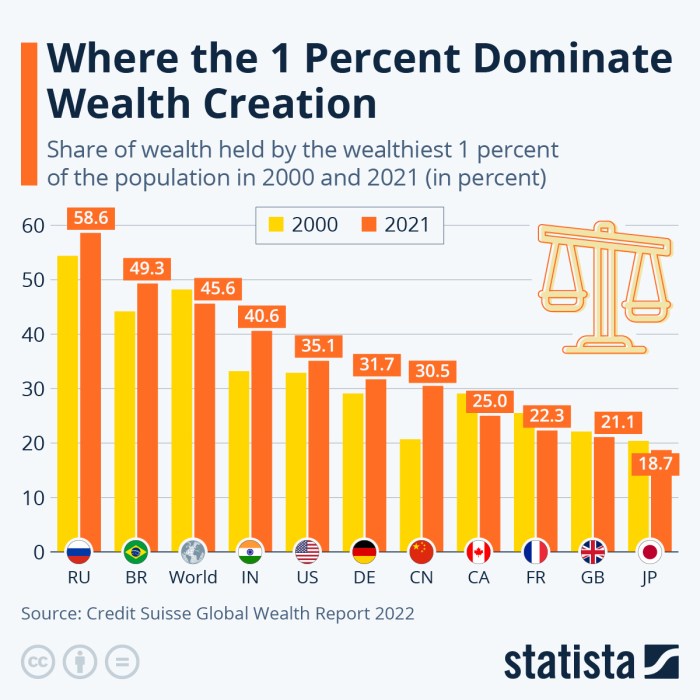
In the United States, the divide between the rich and the poor has been a long-standing issue. The concentration of wealth among the top 1 percent has been a topic of concern for economists, policymakers, and social scientists alike. As of 2022, the top 1 percent in the US holds approximately 39.6% of the country’s wealth, while the bottom 90 percent share only around 27.4%.
This stark disparity in wealth distribution raises questions about the socioeconomic factors contributing to this phenomenon.
Historical Context of Income Inequality in the United States
The roots of income inequality in the US date back to the late 19th century, when the Robber Barons, such as Andrew Carnegie and John D. Rockefeller, accumulated vast fortunes through industrialization and exploitation of workers. The subsequent decades saw the rise of corporate America, with companies like IBM and Microsoft generating enormous wealth through technological advancements and innovative business practices.
However, these gains were not evenly distributed among the workforce, leading to a widening gap between the rich and the poor.
- The Post-World War II Economic Boom
- The Decline of Unionization and Collective Bargaining
- The Rise of Neoliberal Economic Policies
The post-World War II economic boom, fueled by government spending and consumer spending, saw a significant increase in economic growth and a reduction in poverty levels. However, the decline of unionization and collective bargaining in the 1970s and 1980s led to a decline in workers’ bargaining power, allowing corporations to negotiate lower wages and benefits. The rise of neoliberal economic policies in the 1980s, championed by figures like Margaret Thatcher and Ronald Reagan, further exacerbated income inequality by promoting deregulation, privatization, and tax cuts for the wealthy.
Policy Changes Impacting Wealth Distribution
Two significant policy changes have contributed to the concentration of wealth among the top 1 percent: the 2017 Tax Cuts and Jobs Act (TCJA) and the 1999 Gramm-Leach-Bliley Act (GLBA).
- The 2017 Tax Cuts and Jobs Act (TCJA)
- The 1999 Gramm-Leach-Bliley Act (GLBA)
The TCJA, signed into law by President Donald Trump in 2017, significantly reduced corporate tax rates, from 35% to 21%, and introduced new tax deductions and loopholes beneficial to large corporations and high-income individuals. The GLBA, passed during the Clinton administration, repealed parts of the Glass-Steagall Act of 1933, allowing commercial banks to engage in investment activities, thereby increasing the risk of financial crises and exacerbating income inequality.
Insights from the Federal Reserve’s Data on Consumer Spending and Debt
The Federal Reserve’s data on consumer spending and debt provide valuable insights into the socioeconomic factors contributing to income inequality.
- Household Debt-to-Income Ratio
- Consumer Spending Patterns by Income Group
The household debt-to-income ratio has increased significantly since 2008, with the average household debt-to-income ratio rising from 108% in 2008 to 132% in 2022. Moreover, consumer spending patterns reveal that the top 1 percent tends to prioritize investments and savings over consumption, whereas the bottom 90 percent allocate a larger proportion of their income towards debt repayment and essential goods.
“Wealth inequality is a major obstacle to economic mobility and a key driver of social and economic instability.”
Federal Reserve Chairman Jerome Powell
A Comparative Analysis of Net Worth Distribution in the USA vs Other Developed Economies

In a world where the pursuit of wealth and prosperity seems to be a driving force behind economic growth, it’s hard not to notice the stark contrast in wealth distribution between the United States and its developed economy counterparts. From the bustling streets of Tokyo to the tranquil canals of Amsterdam, the disparity in net worth is striking.
But what sets the USA apart, and what can be learned from other nations’ approaches to reducing income inequality? The United States has been ranked among the most unequal developed nations, with the top 1% of earners holding a disproportionate share of the country’s wealth. According to a report by the Economic Policy Institute (EPI), the top 1% of earners in the USA possess over 40% of the country’s wealth, while the bottom 90% hold just 27%.
This glaring disparity has led to widespread discussions on the need for policy changes to address income inequality.
Unique Factors Contributing to the Significant Wealth Gap in the USA
Several factors contribute to the significant wealth gap in the USA compared to other developed nations. One major factor is the lack of a robust social safety net and public services. Unlike many European countries, the USA has a patchwork system of social services, leaving many residents without access to essential benefits like healthcare and education.
Additionally, the USA’s tax system is often criticized for favoring the wealthy, with lower tax rates for corporations and high-income individuals.
Strategies Implemented in Other Countries to Reduce Income Inequality
Many developed economies have implemented successful strategies to reduce income inequality. For example, Denmark offers a comprehensive social welfare system, including universal healthcare, free education, and a robust unemployment benefits program. The country’s progressive tax system ensures that the wealthy contribute their fair share to the social welfare fund. Similarly, Norway’s tax system is designed to redistribute wealth through a combination of high taxes on the wealthy and investments in public services like education and healthcare.
Comparative Analysis of Social Safety Nets and Public Services
A comparative analysis of social safety nets and public services in other developed economies reveals some striking differences. In Finland, for instance, the social safety net is comprehensive and universal, covering basic needs like housing, food, and healthcare. In contrast, the USA’s social safety net is fragmented and often requires individuals to navigate a complex system to access basic services.
| Country | Percentage of Wealth Held by Top 1% of Earners | Percentage of Population Living Below Poverty Line | Tax System |
|---|---|---|---|
| USA | 40% | 13.4% | Progressive tax system with lower rates on corporations and high-income individuals |
| Denmark | 5% | 5.1% | Progressive tax system with high taxes on the wealthy and investments in public services |
| Norway | 5% | 5.5% | Progressive tax system with high taxes on the wealthy and investments in public services |
Lessons Learned from Other Countries
A closer look at other developed economies reveals that a combination of progressive taxation, comprehensive social safety nets, and investments in public services can be an effective way to reduce income inequality. The USA can learn from these countries’ approaches, such as implementing a more progressive tax system, expanding access to universal healthcare and education, and strengthening the social safety net to ensure that everyone has a basic standard of living.
The pursuit of wealth and prosperity is a common goal among nations, but the USA’s unique factors contributing to the wealth gap highlight the need for targeted policy changes to address income inequality. By studying the strategies implemented in other countries and adapting them to its own context, the USA can work towards creating a more equitable society where everyone has the opportunity to thrive.
Mapping the Geographic Areas Where the Top 1 Percent in the USA Tend to Reside
The top 1 percent in the USA has a distinct pattern of geographic distribution, with certain areas experiencing a higher concentration of individuals with extreme wealth. By analyzing the socioeconomic characteristics of these areas, we can gain a deeper understanding of the underlying factors contributing to wealth concentration. This, in turn, may provide valuable insights into the distribution of wealth and the social and economic implications of these phenomena.
Geographic Distribution of Median Household Income
The median household income is a fundamental metric for understanding the economic well-being of communities. However, when examining the top 1 percent, it becomes essential to consider the broader regional context. According to data from the United States Census Bureau (2020), the top 1 percent in the USA tend to reside in areas with higher median household incomes.
| Region | Median Household Income | Wealth per Capita |
|---|---|---|
| San Francisco-Oakland-Hayward, CA | $83,441 | $643,119 |
| New York-Newark-Jersey City, NY-NJ-PA | $72,460 | $555,019 |
| Washington-Arlington-Alexandria, DC-VA-MD | $83,822 | $631,119 |
Urbanization Patterns Contributing to Wealth Concentration
Urban areas tend to exhibit higher levels of wealth concentration compared to rural areas. This can be attributed to a combination of factors, including:* Greater access to higher-paying job opportunities
- Higher levels of financial investment and entrepreneurship
- Increased property values and housing costs
- Greater access to advanced education and professional networks
Most Populous Cities and Metropolitan Areas with High Concentration of Individuals in the Top 1 Percent
The following cities and metropolitan areas have experienced significant growth in the top 1 percent population:* San Francisco, CA (34.4% of households with incomes above $250,000)
- New York City, NY (24.8% of households with incomes above $250,000)
- Seattle, WA (23.1% of households with incomes above $250,000)
- Boston, MA (20.5% of households with incomes above $250,000)
- Washington, D.C. (18.5% of households with incomes above $250,000)
These areas attract high-skilled professionals, entrepreneurs, and investors, contributing to an increase in the top 1 percent population.
Examining the Impact of Business and Entrepreneurship on Net Worth Attainment for the Top 1 Percent in the USA

As we delve into the world of high net worth individuals, it’s clear that business and entrepreneurship play a significant role in attaining significant wealth. Think of the likes of Bill Gates, Mark Zuckerberg, and Elon Musk – these tech moguls have revolutionized the way we live, work, and interact with each other, and in the process, amassed incredible fortunes.
But what drives their success, and what can we learn from their experiences?From tech startups to real estate empires, various business models and industries have contributed to the high net worth of the top 1 percent. For instance, the tech industry has given rise to giants like Google, Amazon, and Facebook, which have transformed the way we shop, communicate, and access information.
On the other hand, the finance industry has produced behemoths like Goldman Sachs and J.P. Morgan, which have dominated the global financial landscape for decades.
Business Models and Industries Contributing to High Net Worth
The business models and industries that contribute to high net worth attainment for the top 1 percent are diverse and far-reaching. Here are some notable examples:
- Tech startups: Companies like Airbnb, Uber, and Lyft have disrupted traditional industries like hospitality and transportation, creating new opportunities for wealth creation.
- Real estate development: Investors like Donald Trump and Richard LeFrak have made fortunes by building and developing high-end real estate projects.
- Finance and banking: Financial institutions like Goldman Sachs and J.P. Morgan have dominated the global financial landscape for decades, generating billions of dollars in profits.
- Healthcare and biotech: Companies like Pfizer and Biogen have developed life-changing medicines and treatments, generating enormous wealth for their shareholders.
- Energy and natural resources: Investors like Warren Buffett have made significant fortunes by investing in energy and natural resource companies.
It’s worth noting that success in these industries often requires a combination of factors, including visionary leadership, innovative products or services, strategic risk-taking, and a deep understanding of the market and regulatory landscape.
Key Characteristics and Skills Required to Succeed as an Entrepreneur in the Top 1 Percent, Net worth of top 1 percent in usa
So, what sets apart entrepreneurs who achieve significant wealth from those who don’t? Here are some key characteristics and skills that are commonly found among high-performing entrepreneurs:
- Strong vision and strategic thinking: High-performing entrepreneurs have a clear understanding of their market, customers, and competition, and are able to develop a compelling vision and strategy to drive growth.
- Innovative problem-solving: Entrepreneurs who achieve significant wealth are often able to identify new opportunities and solve complex problems in creative and effective ways.
- Strong leadership skills: Successful entrepreneurs are often able to inspire and motivate their teams to achieve exceptional results.
- Ability to take calculated risks: High-performing entrepreneurs are often willing to take calculated risks to drive growth and innovation, but also know when to step back and reassess their approach.
- Passion and perseverance: The ability to stay focused and motivated, even in the face of adversity, is essential for achieving success in business.
Notable Entrepreneurs Who Have Achieved Significant Wealth Through Innovative Business Ventures
Here are some notable examples of entrepreneurs who have achieved significant wealth through innovative business ventures:
| Name | Industry | Company | Wealth Creation |
|---|---|---|---|
| Bill Gates | Software | Microsoft | $200 billion+ |
| Mark Zuckerberg | Software | $70 billion+ | |
| Elon Musk | Clean Energy and Space Exploration | SpaceX and Tesla | $200 billion+ |
These entrepreneurs have disrupted traditional industries, created new markets, and generated enormous wealth for their shareholders. Their stories serve as a testament to the power of innovation, risk-taking, and perseverance in achieving success in business.As we continue to explore the world of high net worth individuals, it’s clear that business and entrepreneurship play a significant role in attaining significant wealth.
By understanding the various business models and industries that contribute to high net worth, as well as the key characteristics and skills required to succeed as an entrepreneur, we can gain valuable insights into the secrets of success in business.
Quick FAQs
Q1: What is the primary driver of the wealth gap in the USA?
A1: The primary driver of the wealth gap in the USA is a complex interplay of socioeconomic factors, including income inequality, access to education, and tax policies.
Q2: How does access to higher education impact net worth?
A2: Access to higher education significantly impacts net worth, as it provides individuals with the skills, knowledge, and networks necessary to accumulate wealth and succeed in their careers.
Q3: What are some examples of tax policies that have impacted wealth distribution?
A3: Examples of tax policies that have impacted wealth distribution include the Reagan-era tax cuts, which disproportionately benefited the wealthy, and the 2017 Tax Cuts and Jobs Act, which further increased income inequality.
Q4: How does intergenerational wealth transfer impact the distribution of net worth?
A4: Intergenerational wealth transfer plays a significant role in the distribution of net worth, as inherited wealth and family connections often provide individuals with a significant head start in accumulating wealth.
