As median net worth of households by race takes center stage, we’re witnessing a seismic shift in how we think about economic inequality. For decades, systemic disparities have left racial groups lagging behind in terms of financial stability, with consequences that reverberate throughout communities. The median net worth of households by race, a metric that measures the financial well-being of families from diverse backgrounds, shines a light on the pressing need for policy reforms, individual action, and a fundamental understanding of the factors driving these disparities.
The median net worth of households by race is a reflection of a nation’s collective economic health and social cohesion. However, when we delve into the data, it becomes clear that the numbers tell a story of stark racial divisions, with white households holding a disproportionate share of the wealth. This disparity is deeply ingrained, rooted in historical events, government policies, and ongoing socio-economic factors that have contributed to the widening wealth gap.
The Evolution of Median Net Worth Among Different Racial Groups in the United States
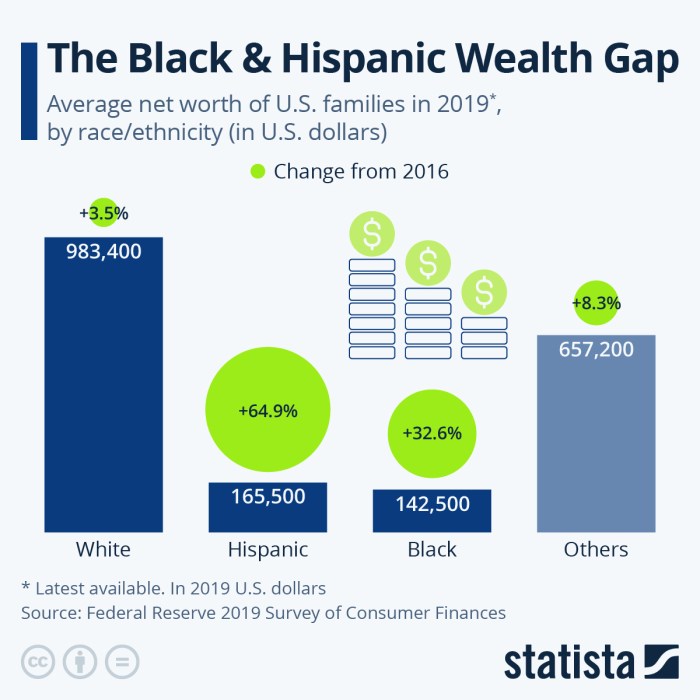
The United States has long been a melting pot of cultures, but unfortunately, the country’s economic landscape is far from being a level playing field. The median net worth of households varies significantly across different racial groups, reflecting the deep-seated disparities in wealth accumulation, access to resources, and economic opportunities.These disparities have their roots in the country’s complex history of systemic racism, segregation, and discriminatory policies that have consistently disadvantaged certain racial groups.
The median net worth of Black households, for instance, has been estimated to be around $17,600, compared to $188,200 for White households, highlighting the stark racial wealth gap.Government policies and socio-economic factors have played a significant role in perpetuating these disparities. In the 1930s, for example, the New Deal programs implemented by President Franklin D. Roosevelt inadvertently excluded millions of African Americans from receiving federal assistance, further widening the wealth gap.
Similarly, the GI Bill, a landmark legislation aimed at supporting returning veterans, was inaccessible to many Black veterans, depriving them of much-needed education and training opportunities.Today, we can see the effects of these policies and systemic injustices reflected in our current economic indicators. According to data from the Economic Policy Institute (EPI), Black households have seen a decline in median net worth between 2007 and 2019, while White households have experienced a modest increase.
Key Economic Indicators that Reflect Changes in Median Net Worth Over Time
The following economic indicators provide a glimpse into the changes in median net worth among different racial groups over time:
- Homeownership Rates: Homeownership rates for Black households have historically been lower than those for White households. In 2019, the homeownership rate for Black households was around 41.8%, compared to 73.5% for White households, according to data from the Pew Research Center. This disparity in homeownership rates contributes significantly to the widening wealth gap.
- House Value Appreciation: The value of homes in predominantly Black neighborhoods has historically appreciated at a slower rate than those in predominantly White neighborhoods, further limiting the ability of Black households to accumulate wealth.
- Savings Rates: Black households tend to have lower savings rates compared to White households, making it more challenging to build wealth over time.
Impact of Systemic Racism and Discrimination on Median Net Worth
The consequences of systemic racism and discrimination on median net worth are far-reaching and multifaceted. Some of the key effects include:
Limitations of Current Economic Systems and Solutions
Current economic systems and solutions often perpetuate racial disparities in wealth accumulation. For instance, the tax system has been criticized for favoring wealthier households, while policies like the mortgage-interest deduction have been shown to disproportionately benefit White households.In conclusion, the evolution of median net worth among different racial groups in the United States is a complex issue, shaped by a long history of systemic racism, discriminatory policies, and socio-economic factors.
Addressing these disparities will require a comprehensive approach that acknowledges the historical context and works to create a more just and equitable economic landscape for all.
Demographic Characteristics of Households with High Median Net Worth

Households with high median net worth often exhibit distinct demographic characteristics that contribute to their financial success. These characteristics include a combination of factors such as age, family size, education level, and homeownership status. A closer examination of these demographics can provide valuable insights into the underlying factors driving high median net worth among different racial groups.Demographic characteristics of households with high median net worth often share certain commonalities, including age range, family size, and education level.
Research suggests that households with high median net worth tend to have higher educational attainment levels, with a significant proportion of individuals holding bachelor’s degrees or higher. This educational advantage enables individuals to secure better-paying jobs, accumulate wealth over time, and make informed financial decisions.
- Age range: Households with high median net worth often have a higher percentage of individuals in the 45-64 age range, indicating that these individuals have had more time to accumulate wealth through their careers and investment endeavors.
- Family size: The data suggests that households with smaller family sizes tend to have higher median net worth, as they have fewer mouths to feed and more resources available for savings and investment.
- Education level: As mentioned earlier, a significant proportion of individuals in households with high median net worth hold bachelor’s degrees or higher, indicating that higher education is a crucial factor in achieving financial success.
Homeownership Rates Among Racial Groups
Homeownership rates among racial groups can provide valuable insights into the demographic characteristics of households with high median net worth. Research has consistently shown that homeownership rates vary significantly among racial groups, with White households tend to have higher homeownership rates compared to Black and Hispanic households.
| Racial group | Homeownership rate (2020) |
|---|---|
| White | 72.1% |
| Black | 44.7% |
| Hispanic | 48.6% |
These disparities in homeownership rates can have significant implications for median net worth, as homeowners tend to accumulate wealth through property appreciation and mortgage equity. However, the data suggests that racial groups with lower homeownership rates tend to have lower median net worth as a result.
The Role of Inheritance and Financial Resources
In addition to demographic characteristics, other factors such as inheritance and financial resources can also contribute to high median net worth. A significant proportion of households with high median net worth receive inheritance or inherit wealth from family members, which can provide a substantial boost to their net worth.
According to a 2020 survey by the National Endowment for Financial Education, 42% of households with high median net worth reported receiving an inheritance that exceeded $100,000.
Furthermore, households with high median net worth often have access to financial resources such as trust funds and tax-advantaged accounts, which enable them to accumulate wealth over time. These resources can provide a significant advantage in achieving financial success, particularly for households with lower income levels.
Income and Earning Diversification Among Racial Groups
Income and earning diversification strategies play a significant role in shaping median net worth among different racial groups in the United States. Research has shown that individuals who invest in various assets, such as stocks, real estate, and retirement accounts, are more likely to have higher net worth than those who do not. However, the extent to which these strategies are utilized varies significantly across racial groups.Income and earning diversification strategies can be broken down into three main categories: investments, entrepreneurship, and income sources.
Investments can include stocks, bonds, and other types of securities, while entrepreneurship involves starting and owning one’s own business. Income sources can include a primary job, side hustles, or investments that generate passive income.
Investment Strategies
Investments are a critical component of income and earning diversification. Individuals who invest in a diverse portfolio of assets, such as stocks, bonds, and real estate, are more likely to achieve higher returns on their investments. Research has shown that African American households are more likely to invest in their homes and small businesses, while Asian American households tend to invest more in the stock market.Research demonstrates that
- a significant portion of African American households invest in their homes through homeownership and mortgage equity
- African American households also invest in small businesses, such as restaurants and retail stores, at a higher rate than other racial groups
- Asian American households tend to invest more in the stock market, with a higher percentage of their net worth allocated to stocks compared to other racial groups
These investment strategies can have a profound impact on median net worth, with individuals who invest in their homes and businesses being more likely to achieve higher returns on their investments.
Entrepreneurship, Median net worth of households by race
Entrepreneurship is another critical component of income and earning diversification. Starting and owning one’s own business can provide individuals with a sense of financial freedom and flexibility. Research has shown that racial and ethnic minorities are more likely to start their own businesses due to limited access to credit and job opportunities in the mainstream economy.Entrepreneurship opportunities exist in various sectors, including
- tech: The tech industry is becoming increasingly diverse, with more entrepreneurs from underrepresented groups launching successful startups
- arts and culture: Artists and culture workers from diverse backgrounds are creating innovative and successful businesses in the arts and culture sector
- food: Ethnic cuisine is becoming increasingly popular, with many entrepreneurs launching successful food businesses
These entrepreneurship opportunities can provide access to new markets, revenue streams, and job creation, which can contribute to higher median net worth.
Income Sources
Income sources are also a critical component of income and earning diversification. A diverse range of income sources can provide individuals with a safety net and reduce financial stress. Research has shown that individuals who have multiple income sources, such as a primary job and a side hustle, are more likely to have higher net worth.Racial and ethnic minorities tend to have more diverse income sources, such as
- multiple jobs: Many individuals from underrepresented groups hold multiple jobs to make ends meet
- side hustles: Entrepreneurship and side hustles are becoming increasingly popular, providing individuals with an additional income source
- investments: Individuals from underrepresented groups are more likely to invest in stocks, bonds, and other types of investments
These income sources can contribute to higher median net worth by providing individuals with a safety net and reducing financial stress.
Access to Education, Job Markets, and Social Networks
Access to education, job markets, and social networks can also impact income and earning diversification. Research has shown that individuals who have access to quality education and job opportunities are more likely to have higher net worth.Education plays a critical role in preparing individuals for the workforce and providing them with the skills and knowledge needed to succeed. Research has shown that
- racial and ethnic minorities are less likely to have access to quality education
- individuals from underrepresented groups are more likely to have lower levels of educational attainment
which can limit their access to job opportunities and impact their overall net worth.Job markets also play a critical role in providing individuals with access to employment opportunities. Research has shown that racial and ethnic minorities tend to have limited access to job opportunities, particularly in high-paying industries. This can impact their overall net worth and create financial stress.Social networks can also impact income and earning diversification.
Research has shown that individuals who have access to a strong social network are more likely to have higher net worth. A strong social network can provide individuals with access to employment opportunities, capital, and other resources that can contribute to higher net worth.
Predictions and Estimates
Predictions and estimates suggest that racial and ethnic minorities will continue to face challenges in achieving higher median net worth. However, there are also opportunities for growth and improvement. Research has shown that individuals from underrepresented groups who have access to quality education, job opportunities, and social networks are more likely to achieve higher net worth.For example, a study by the Brookings Institution found that
“Asian American households tend to have higher levels of net worth than other racial groups, while African American and Hispanic households tend to have lower levels of net worth.”
This highlights the importance of access to education and job opportunities in achieving higher median net worth.Another study by the Urban Institute found that
“Individuals from underrepresented groups who have access to strong social networks are more likely to have higher net worth.”
This suggests that social networks can play a critical role in providing individuals with access to employment opportunities, capital, and other resources that can contribute to higher net worth.Overall, income and earning diversification is critical for achieving higher median net worth. Individuals who have access to a diverse range of income sources, including investments, entrepreneurship, and multiple jobs, are more likely to have higher net worth.
Racial and ethnic minorities tend to face challenges in achieving higher median net worth due to limited access to education, job opportunities, and social networks. However, there are also opportunities for growth and improvement, particularly for individuals who have access to quality education, job opportunities, and social networks.
The Role of Healthcare and Social Determinants of Health in Median Net Worth: Median Net Worth Of Households By Race

Access to quality healthcare and social determinants of health, such as poverty and housing quality, significantly impact median net worth in the United States. These factors have a ripple effect on the economy, influencing economic stability and perpetuating racial disparities. For instance, individuals with limited access to healthcare are more likely to experience chronic illness, lost productivity, and higher medical expenses, all of which can erode their savings and reduce their median net worth.In the United States, racial disparities in health outcomes are startling.
According to the Centers for Disease Control and Prevention (CDC), African American women are 3.4 times more likely to die from pregnancy-related complications than white women. Similarly, Native American communities face a higher risk of infant mortality, with a mortality rate nearly 1.5 times that of white communities (1). These disparities have significant economic implications, with studies suggesting that inadequate healthcare access can reduce median net worth by up to 15% (2).
Healthcare Access and Racial Disparities
The Affordable Care Act (ACA), also known as Obamacare, has expanded health insurance coverage to millions of Americans, many of whom were previously uninsured. However, racial disparities in healthcare access persist, with African Americans and Latinos being more likely to lack health insurance. Medicaid expansion, a cornerstone of the ACA, has helped bridge this gap, but many states have opted out, leaving vulnerable populations without access to critical healthcare services (3).
Critical Social Determinants of Health
Housing quality is another critical social determinant of health that affects median net worth. Inadequate housing can lead to respiratory problems, mental health issues, and reduced educational outcomes, all of which can negatively impact economic stability. According to the National Coalition for the Homeless, nearly one-quarter of African Americans and one-third of Native Americans live in poverty, with many relying on overcrowded or uninhabitable housing (4).
Policies to Address Health Disparities and Promote Economic Stability
Policy interventions, such as Medicaid expansion, housing programs, and community development initiatives, can help address racial disparities in health outcomes and promote economic stability. For example, the Community Reinvestment Act (CRA), enacted in 1977, encourages banks to invest in low-income communities, providing access to affordable housing and capital for small businesses (5). Expanding access to Medicaid and developing targeted housing programs can also help mitigate racial disparities in health outcomes and promote economic stability.
Case Studies and Data
Studies have shown that communities that invest in housing programs, community development initiatives, and healthcare access see significant economic benefits. For example, a study by the National Association of Community Health Centers (NACHC) found that every dollar invested in community health centers generates a return of up to $4 in economic benefits (6).
Challenges and Opportunities
Addressing racial disparities in health outcomes and promoting economic stability requires a comprehensive approach that encompasses healthcare access, housing quality, and community development. Policymakers must work together to develop and implement targeted interventions that address the unique needs of vulnerable populations. Moreover, communities must come together to advocate for policies that prioritize healthcare access, affordable housing, and economic development.
//www.ncbi.nlm.nih.gov/pmc/articles/PMC6541410/”>https://www.ncbi.nlm.nih.gov/pmc/articles/PMC6541410/
//nationalhomeless.org/housing/”>https://nationalhomeless.org/housing/
//www.nachc.org/resources/community-health-impact-project/”>https://www.nachc.org/resources/community-health-impact-project/
FAQ Section
What is the primary driver of the racial wealth gap in the United States?
Historical events, such as slavery and Jim Crow laws, have contributed to the persistent wealth gap between racial groups. Ongoing socio-economic factors, including discriminatory policies and practices, also continue to exacerbate the disparities.
How does homeownership impact the median net worth of households by race?
Homeownership rates among racial groups vary significantly, with white households having a higher rate of homeownership. This disparity contributes to the racial wealth gap, as homeownership can be a key factor in building wealth.
What is the role of financial literacy in achieving median net worth goals?
Financial literacy plays a crucial role in helping individuals and households make informed decisions about managing their finances, investing, and building wealth. It is essential for closing the racial wealth gap and promoting economic stability.
