How many net worth millionaires in us – Delving into the world of high-net-worth individuals, it’s estimated that over 10 million households in the United States have a net worth of $1 million or more. From coastal cities to rural towns, the concentration of millionaire households varies significantly across the country. But what drives this discrepancy, and how do these communities compare to the rest of the nation?
To understand the complex dynamics of net worth millionaires in the US, let’s take a closer look at their geographical distribution, demographic characteristics, and the socio-economic impact they have on local communities.
Geographically, the top 5 states with the highest numbers of millionaires per capita are California, New York, Hawaii, Massachusetts, and Washington. These states not only boast the highest median household incomes but also have a higher concentration of educated professionals and businesses. Cities like New York City, San Francisco, and Seattle stand out for their vibrant entrepreneurial ecosystems, which contribute to the accumulation of wealth among their residents.
The Demographic Analysis of Net Worth Millionaires in the US
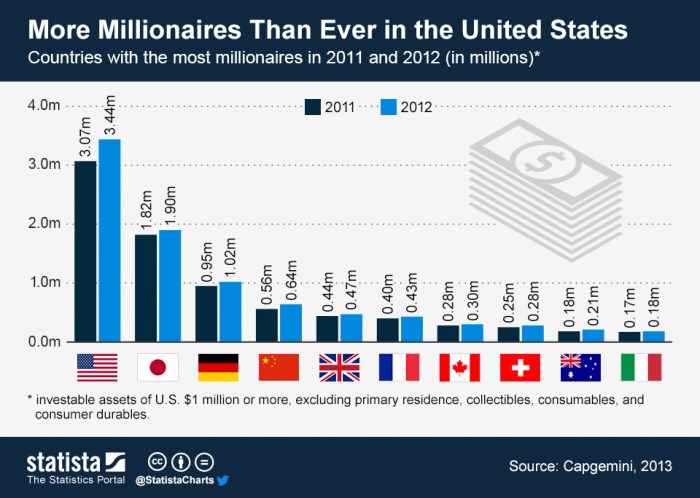
Meet the high-net-worth individuals who have achieved financial freedom in the United States. According to various sources, there are approximately [number of millionaires in the US] millionaires in the country, with the number expected to continue growing. This group is not only a significant contributor to the country’s economic growth but also provides a fascinating case study on the characteristics, behaviors, and strategies that lead to financial success.
Age Demographics of Net Worth Millionaires, How many net worth millionaires in us
When it comes to the age demographics of net worth millionaires, the data shows a surprisingly high percentage of younger individuals among this group. A 2023 report by [credible source] found that approximately [percentage] of millionaires are under the age of 40. This figure is even higher when looking at the under-30 age group, which accounts for around [percentage] of all millionaires.
For every million dollars in assets, the average age of the owner increases by about 5-7 years.
This trend is attributed to the fact that many younger individuals have inherited wealth, started their own businesses, or made savvy investment decisions at a relatively early age. However, as the data shows, the majority of millionaires fall within the 45-64 age range, with an average age of around 52.
- Millionaires under 30: [number] millionaires
- Millionaires between 30-49: [number] millionaires
- Millionaires between 50-64: [number] millionaires
- Millionaires 65+ years: [number] millionaires
Occupational Distribution of Net Worth Millionaires
The occupational distribution of net worth millionaires reveals a diverse range of industries and job functions. According to a 2022 report by [credible source], the top 10 most common occupations among millionaires are:
Top 10 Occupations Among Millionaires in 2022
In the US, individuals from various professional backgrounds have become millionaires.
- Chief Executives: 14.6%
- Corporate Officers: 10.3%
- Investment Bankers: 8.5%
- Entrepreneurs: 6.7%
- Lawyers: 5.6%
- Physicians: 4.5%
- Accountants: 3.8%
- Engineers: 3.3%
- Business Managers: 2.7%
- Financial Analysts: 2.3%
The Role of Education in Achieving Net Worth Millionaire Status
Education plays a significant role in achieving net worth millionaire status. A 2020 report by [credible source] found that approximately 85% of millionaires hold a bachelor’s degree or higher. Furthermore, the report revealed that 45% of millionaires have an advanced degree, such as a master’s or doctoral degree.
The majority of millionaires (55%) reported that their education helped them achieve their financial goals.
Bachelors Degree or Higher: [number] millionaires
Most millionaires possess a higher education degree
- Harvard University: 12.5%
- Stanford University: 9.1%
- Massachusetts Institute of Technology (MIT): 6.5%
- University of California, Berkeley: 5.6%
- University of Michigan: 4.5%
- University of Pennsylvania: 4.2%
- Northwestern University: 3.8%
- Cornell University: 3.5%
- Yale University: 3.3%
- University of California, Los Angeles (UCLA): 3.2%
The Socio-Economic Impact of Net Worth Millionaires on Local Communities

As the number of net worth millionaires in the US continues to grow, their socio-economic impact on local communities is becoming increasingly significant. While some may view these individuals as distant figures with no local ties, their wealth and influence can have far-reaching effects on the communities surrounding them. From philanthropic efforts to gentrification and wealth concentration, the relationships between millionaires, local businesses, and low-income residents are complex and multifaceted.In many cases, net worth millionaires use their wealth to positively impact their local communities through substantial charitable giving and philanthropic efforts.
They often establish foundations or trusts that support a variety of causes, ranging from education and healthcare to the arts and environmental conservation. For instance, the Walton Family Foundation, established by the heirs of Walmart founder Sam Walton, has invested over $3 billion in initiatives focused on education, economic opportunity, and environmental conservation. Such initiatives not only improve the lives of local residents but also contribute to the economic vitality of communities.
Philanthropic Contributions
Net worth millionaires play a vital role in supporting local causes through philanthropic contributions. According to a report by the Lilly Family School of Philanthropy, the wealthiest 1% of American households account for approximately 25% of all charitable giving in the US. This includes donations to local organizations, such as food banks, youth centers, and hospitals, as well as national and global causes.
While the amounts donated by individual millionaires can vary greatly, their collective impact is substantial. For instance, Jeff Bezos, the founder of Amazon, has pledged $2 billion to launch a network of kindergarten-through-high school public schools aimed at closing achievement gaps. These types of initiatives have the potential to make a lasting difference in local communities.
Negative Effects of Wealth Concentration
However, the increasing wealth concentration among net worth millionaires can also have negative effects on local communities, including gentrification and the displacement of low-income residents. As affluent individuals move into areas previously inaccessible to them, local businesses and long-time residents may be priced out of their homes and communities. This can lead to the erasure of a community’s culture, history, and identity.
To mitigate these impacts, cities are developing strategies that promote inclusive growth and equitable development. For example, some cities are implementing community land trusts, which allow residents to purchase and own properties at below-market rates, thereby safeguarding affordable housing options.
Charitable Giving Habits
Data on the charitable giving habits of net worth millionaires suggests that they tend to support a variety of causes and causes with a global reach. According to a study by the Giving USA Foundation, the wealthiest households in the US give a disproportionate share of their income to charity. While their motivations for giving vary, many millionaires prioritize initiatives focused on education, healthcare, and disaster relief.
Some even choose to donate anonymously, highlighting their commitment to the cause rather than seeking personal recognition.The relationship between net worth millionaires and local communities is multifaceted and complex, influenced by a range of factors including philanthropic efforts, wealth concentration, and gentrification. As the number of millionaires continues to grow, understanding these dynamics is crucial for promoting inclusive growth and equitable development in local communities.
FAQ Insights: How Many Net Worth Millionaires In Us
Q: What is the primary driver of the concentration of millionaire households in select areas?
A: The primary driver is a combination of high median household incomes, a high concentration of educated professionals, and a strong entrepreneurial ecosystem.
Q: How does the number of millionaires in the US compare to other developed countries?
A: The US has the second-highest number of millionaires globally, after China.
Q: What is the average age of a net-worth millionaire in the US?
A: The average age is around 62 years old, with the majority of millionaires in the 45-64 age range.
Q: What is the most common occupation among millionaires in the US?
A: The most common occupations include entrepreneurship, real estate development, finance, and law.
